Sunday, November 23, 2014

Zapruder, Camelot, and "the Real America."

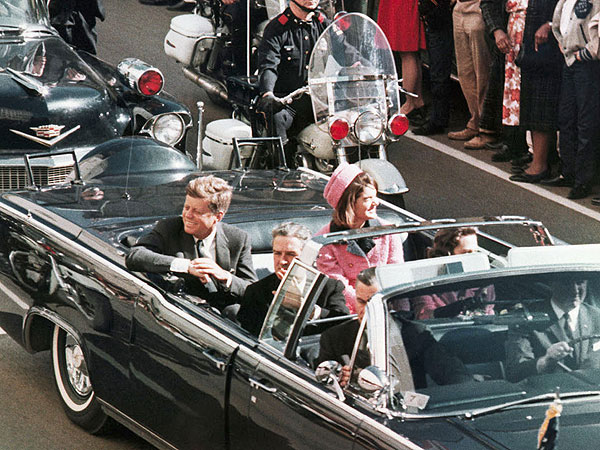
President Kennedy moments before he was assassinated in Dallas, November 22nd, 1963. (Courtesy: People).

(The following was written a year ago to commemorate the 50th anniversary of the Kennedy assassination.  It was heretofore unpublished.)


“It's no wonder that truth is stranger than fiction. Fiction has to make sense.”
-Mark Twain.
“In my stars I am/ above thee, but be not afraid of greatness…
/Thy Fates open/ their hands. Let thy blood and spirit embrace them.”
-Shakespeare (Twelfth Night, Act II Scene V).

In the course of our recent, dare I say uniquely-American, “celebration” of the fiftieth anniversary of the assassination of President Kennedy in Dallas, and the frantic hunt by conspiracy theorists and other scholars to finally discover some long-hidden deeper meaning to it all—a desperate search to finally find out “why?”—I came to a realization that shines light on the story from an entirely different perspective. It’s really the most important perspective that we have; and sadly it’s sometimes overlooked, taken for granted by too many of those who have seen it.

If there is any deeper meaning to be gleaned from the events of November 22nd, 1963 in Dealey Plaza, it lies with one man, a very certain shooter who was standing on that infamous grassy knoll. No, not that kind of shooter. My meaning isn’t some shadowy character hiding behind a picket fence with a gun. That sort of shooter only lives in the minds of Oliver Stone and his ilk. The shooter I reference, on the other hand, is very real and easily defined. He was armed not with a sniper’s rifle, but with a Zoomatic 8mm video camera. He shot not bullets at the President, but instead the most important 26.6 seconds of grainy silent film ever taken in American history.

His name was Abraham Zapruder. And as Jack Kennedy slumped over into his wife’s lap and died, it was Zapruder who quickly became the most important man on the scene. In an oddly prophetic way it seems appropriate that it would be the Ukrainian-born dressmaker who filmed the only visual evidence of the most infamous murder of the twentieth century. Especially considering his origin, that he ran halfway across the globe to escape the horrors of the Russian Civil War and the consolidation of Lenin’s hold on power, it comes across as a darkly perfect example of an “only in America” moment—the idea that anyone from anywhere can be anything—that the foreign-born small business man would have his name forever attached to the name of one our nation’s most revered leaders, immortalized for the ages by the ghastly sight of “Zapruder frame 313” (the ever-chilling image of the third bullet tearing through Kennedy’s head).

But that’s not really enough, is it? Something larger tugs at the mind. Perhaps this is something grander in scale, a proof of Shakespeare’s human universality that “some have greatness thrust upon 'em,” that anyone can by chance (be it luck, fate, or however else you might have it) become, if not powerful, at least of the highest importance.

Perhaps we really have been looking in the wrong direction. Perhaps we’ve spent too many years looking for why Jack Kennedy died and not enough time thinking about what his death really meant. For what it’s worth, I don’t hate Kennedy. On balance, I have something of a respect for him. A man whose platform was for tax cuts, balanced budgets, and civil rights was an admirable man indeed. Throw in a hard line against the Soviets and communism, and that goes double. His firm stance during the Cuban Missile Crisis, worthy of its long remembrance in the American mind, was rightly the genesis of his legacy. But, fittingly enough, his was a legacy that to survive almost had to be sealed in blood.

“Camelot,” that gaudy monstrosity of a name by which we’ve been told we are to remember that lurid time, was a lie, even if it was a good one. From his supposed perfect marriage to the fashion icon wife, to his rock-star persona (with the built-in personality cult), and the constant parties, the omnipresence of refined culture and high society, everything surrounded by regal furnishings, it was all a hollow sham. In his real personal life he was anything but virtuous. He was an idealist, and maybe a great one at that, but he was a much better at saying than he ever was at doing. “Getting things done,” as we call it, would be left to that wretched lug Lyndon Johnson, and get things done he sure did (not just stopping at the just and noble goal of civil rights; but continuing on to an alarming big government state, his “great society,” whose own legacy ought to be forever questioned in its own right).

No, much like the mythic King Arthur and his court, the Kennedy Camelot wasn’t real. More importantly it wasn’t the real America. Shakespeare’s quote from Twelfth Night has two other parts; a large fraction of the other great leaders in American history all did great big things, they were amongst the some who “achieve greatness.” Washington, Lincoln, Jefferson, Hamilton, Madison, Reagan, both of the Roosevelts, Eisenhower…the list of names that come to mind goes on and on. Kennedy, however, was different. Jack Kennedy was “born great,” but achieved little. Jack Kennedy, whatever good there is to say about him, is nothing quite like anyone on the list above (regardless of how you feel about him or anyone on that list). He was a rich kid with connections and a good war story (this is not to discredit the valor of his service), “chosen” by his father to be President because his older brother had the bad fortune of dying young.

Abraham Zapruder, on the other hand, was exactly what defines “the real America.” He was a self-made man, not of great distinction, but not of poor disposition, either. He came to the other side of the globe not for any guarantees, but for a chance to succeed (not at all unlike my own grandfather, incidentally). In the course of many years spent in the shuffle of the free market, he had the good fortune of doing well for himself. By that good fortune he bought a movie camera, a top of the line model.

This fairy tale of Camelot simply could not survive forever. At some point the bubble would have to burst, yet no one could ever have expected it to play out the way it did. It all ended with a crack of thunder when the President was slain in the back of his own limousine as it rolled down Elm Street. And Zapruder just stood there and watched, and filmed. Jack Kennedy died, and the car sped off. The metaphor in there is dark, but it can’t be denied. Zapruder and his film are the real America, watching in stunned silence, as the great sham falls apart in front of them. And then, as he rolled off screen, the real America switched off its camera and moved on. The lie was now unraveled, even if violently and unexpectedly so. It was now relegated to memory, an image of a time that was. But Zapruder’s world, the aforementioned “real America,” is grounded in firmer reality, and so outlived Camelot.

In the end, regardless of any symbolic meaning that may be gleaned from the circumstance of his death, the fact remains that Jack Kennedy really and truly died for nothing.  While many specifics will always remain vague, general motive is unbelievably straightforward: Lee Harvey Oswald, the discontented Marxist sociopath, struck out, alone, just so that he could finally prove to the world that he was powerful (Peter Jennings and computer animator Dale K. Myers, in The Kennedy Assassination: Beyond Conspiracy, present a powerful visual argument that lays sole responsibility on Oswald). Around this, the who, what, when, where, and how of the crime all fall into place with relative ease. The complete opposite of Lincoln and Booth, Oswald’s personal interest in Kennedy was all but negligible. Kennedy was condemned by sad coincidence; Oswald’s animus against Kennedy stems only from that fate had decided to drive the President past his place of employment before anyone else of public importance could be. The homicide of the century was set in motion not by hungry schemers, but by total chance. A roll of the dice, if you will.

Such a concept ultimately leads to a sort of psychological disconnect. We can’t accept this, William Manchester explains, so we let ourselves believe in things that we can’t prove. He says, “to employ what may seem an odd metaphor,” we don’t have any problem accepting the Holocaust, because if the two sides were put on a scale “you have a rough balance: greatest crime, greatest criminals.” Put Kennedy and Oswald on either side of the same scale, however, and the President weighs it down. So “you want to add something weightier to Oswald. It would invest the President’s death with meaning…He would have died for something. A conspiracy would, of course, do the job nicely.”

Somehow, after all of this, yet one more strange twist of irony remains. Whatever personal resentments Oswald may have harbored against Jack Kennedy, killing him may very well have only served to set him free. A brief examination of contemporary history shows that the constraints of time (particularly second-terms) have a long record of causing fatigue. Influences wane, and new guards are swept in. But this isn’t so with the dead Kennedy; there are no term limits on martyrs, and for his personality cult, that’s what he had now become.

“Camelot,” as a name for the time, wasn’t even a thing until after he died. Jackie came up with it. Camelot was a musical, and apparently his favorite line was "Don't let it be forgot, that once there was a spot, for one brief shining moment, that was known as Camelot." Evidently she wasn’t sure if that was obvious enough, so she kept going until all of her doubts were erased. "There'll be great Presidents again," she goes on, "but there'll never be another Camelot again … it will never be that way again."


But what if he hadn’t died? What if that “brief shining moment” hadn’t been so brief? Would Jack Kennedy have been such a uniquely great President, would that spot still have been known as Camelot? Well, in a word, no. Had he lived to see the end of his first term and moved into his second, I see a Presidency that would have played out like a watered-down Johnson administration. With his support for civil rights and fierce opposition to the communists, he still would have crushed Barry Goldwater in ’64. Like Johnson, he would be long remembered for the Civil Rights Act of 1964, but in his own time likely affected by Vietnam. No, this Camelot wouldn’t have ended under a storm of bullets, and wouldn’t have been remembered as such. This Camelot would’ve collapsed under the weight of hard reality, washed away by the second coming of Tricky Dick.
-Mitch Carter, a history/secondary education major at Aurora University, is an Illinois State Scholar and member of the Kendall County Young Republicans.

Monday, November 10, 2014

The Neat Idea That Worked

Illinois Governor-elect Bruce V. Rauner (R). (Courtesy: Chicago Sun-Times).

I’ll have to be frank and admit that when I got the idea last Tuesday night to write this it was at a point when I actually thought Bruce Rauner was on his way to losing the gubernatorial election. After jumping out to a lead in the very early returns, the numbers from Cook County really started to come in, and things were swinging in favor of Gov. Quinn. At that point I began thinking to myself, “you backed this guy, this socially moderate, Mitt Romney-esque venture capitalist outsider from the beginning…what are you going to say when he loses?” The answer I found was actually pretty simple: to be spoken in my best imitation of Ollie North, “well, it was just a neat idea.”

Well, fortune smiled on us Tuesday night, and Rauner began to pull ahead in the results just as the Cook County returns began to taper off. Before too long, it seemed, he cracked 50% of the vote and never gave it back. At about 11:30, the Wall Street Journal online feed refreshed, and posted banner proclaiming “Illinois Elects a Republican Governor;” as hard as I wished, part of me had long doubted that I’d ever actually get to see those words.

We are yet, of course, to see how things will pan out with him; we have a full four years, at least, of Governor Rauner ahead of us, which are yet to truly begin. And I do suspect that they will be four long, tense years if Speaker Madigan gets his way.

In just the mere days following his election, he’s already made moves that have piqued the interest. First, he added Bill Daley, son and brother to those Mayors Daley, and chief of staff to that President Obama, to his transition team. And then he declared himself in favor of a minimum wage hike, contra his varying stances throughout the campaign on the issue. But so far I’m of the opinion that these things smell worse than they really taste.

In order for the presence of a Daley to taint your view of this “transition team” beyond recovery is to perceive him as more vibrant a color than he really is in this veritable rainbow of Illinois politics, mixed in as he is with the likes of Gov. Edgar (the last former Governor, of either party, to not wind up in prison), James Meeks and Corey Brooks (the black reverends who stuck their necks out for Rauner, and took some real heat for it), 33 year old Republican Congressman Aaron Schock, Judy Baar Topinka’s chief of staff, a former top staffer to Mark Kirk, and some assorted characters. At the head is soon-to-be Lieutenant Governor Evelyn Sanguinetti, whose passion for saving Illinois I learned of first hand when she sat down at my table at a GOP function last spring.

In short, Bill Daley is nothing more than a nice “bipartisan reach out to the machine” gesture wrapped up inside a who’s who of every non-felonious character-type they could get to line themselves up against the Madigan machine. So I respect the political game he’s playing, and for now I’ll remain unbothered by it.

That thing about raising the minimum wage isn’t really a full cave either, if you take into account all that he actually said, namely that  “the critical thing is that we do it an overall context where we drive up Illinois’ competitiveness, as I’ve always said.” By “overall context,” he means “raising the wage only with a series of tax reforms, tort reform and changes to workers’ compensation laws.” Bruce rode a wave of frustration and populism all the way from virtual obscurity to being elected Governor of the fifth most populous state in the union; that he might attempt to co-opt such a blatantly populist initiative as hiking the minimum wage to $10 on the condition of carve outs for businesses that correspond with his campaign rhetoric isn’t the worst move he could make. After all, it seems almost certain the measure will be approved very near future, notwithstanding mine and other’s objections. If the new Governor could force a compromise on so volatile an issue so early on, I would regard that a good start. If he can’t, it was likely a forgone conclusion anyways. I’ll give him another pass here. For now.

From the beginning, Bruce Rauner’s appeal wasn’t for being a hardliner conservative any sort of ideological purist like that. In the optimal scenario, a fella like Bill Brady would be Governor of Illinois. But we don’t live in that scenario; Bill Brady lost four years ago, and for all I know he might have lost again last week if we had nominated him for the second time. And in that lies what makes Bruce Rauner the “neat idea”: he wasn’t just another Republican archetype out of the state house. He was something new, that we hadn’t done before. A guy who decided to put himself out there because fixing the state means that much to him. And given the common dissatisfaction with Pat Quinn around the state, I figure that it wouldn’t have been that hard for him to have bought off the Democrat primary and sailed to a much easier victory, if he was lying and this was really him working for himself. But he didn’t do that, he signed up as a Republican and decided to take the harder path. That tells me something about him, something good.

I remember when I first encountered his name as the subject of a John Kass column. It was by no means an endorsement, but if you say someone “could be just the ticket to take on status quo,” that’s not an unfavorable introduction, either. “He has millions to spend on his campaign. And that frightens other Republicans, and Democrats, too. Politicians like colleagues who can be leveraged. There's something attractive about a candidate who can't be bought, especially in Illinois, where so many are for sale;”
“What's fascinating about Rauner is his independence. And an unapologetic candidate with his kind of wealth…threatens the political order. ‘I think I'm going to be very dangerous to the people in Springfield,’ he said. ‘I think they're going to be scared. They should be. Because I can't be bribed, influenced, intimidated, threatened. I just want the state fixed and I just want to do the right thing for the taxpayers. You're right, I've done well in business. I'm very proud of it. I've got the resources to do whatever it takes to win, and to do what it takes to help fix the state. ... And the powers down there that like the status quo, they should be very scared,"
“I don't care about a political career. I certainly don't need a job. Getting re-elected is not on my top 10 list. I'll be willing to do things that politicians won't do. Because I don't care who I upset." Interesting, I thought. Very interesting.

Not long after, I happened to run into him at a Reagan day dinner. Tall, deep voice, walking success. Presence. This could really be something. I met up with him a second time at a Republican pig roast function, saw the whole Harleys and flannels thing first hand. Mentioned learning of him through Kass months prior, he said something about John having been very good to him. No kidding there; he might not have said it in exactly so many words until just before the election, but Kass was as much the driving force behind his early campaign as anyone. And John Kass is about the most level-headed guy in Illinois politics, so I took it all to mean something with real potential was brewing.

Chance (and a whole lot of political money) would have it that I backed the right man; Rauner beat back Kirk Dillard in the primary, and now that “neat idea” was moving on to either work out or go down in flames. One really nasty election later, with one Chicago Democrat Governor beaten back, it’s yet to spectacularly go down in flames. It all might still just work out.

-Mitch Carter, a history/secondary education major at Aurora University, is an Illinois State Scholar and member of the Kendall County Young Republicans.

Monday, November 3, 2014

Why Vote?

(Image courtesy: Fresno State News).
The following is adapted from a persuasive speech I delivered to a speech communications class I took at Waubonsee Community College this past summer.

When I had the honor of addressing a gathering of Illinois’ American Legion leadership at their Constitutional speech contest this spring, I spoke to them about the idea of the American system of government being seen through the prism of what I call the “Lincolnian Triangle,” expounding on what stands behind that “government of the people, by the people, for the people.” And within its most important cornerstone, I concluded, lies the vote, the “people’s power to vote, to choose their leaders, to decide their own future;” for which of our precious political freedoms can be greater or purer than the one which allows us to compose for ourselves the government that shall define and enforce the laws which we shall live under?

But unfortunately, it is apparent that not enough Americans see fit not only to “do their civic duty,” but also to take full advantage of this civic liberty of theirs that they are so lucky to be afforded. According to data compiled by Dr. Michael McDonald at George Mason University, between 1948 and 2012, the Presidential election with the highest turnout was 1960 (in which Jack Kennedy defeated Richard Nixon), with about 63% of eligible voters casting a ballot; in this same time span, nine of the seventeen Presidential elections therein have seen less than 60% turnout, meaning that more than 4 in 10 members of the American electorate did not have their opinion counted in the process of selecting their head of state. As noted in an entry in the journal Issues: Understanding Controversy and Society, “In 1996, less than 50% of eligible voters chose to exercise the vote, the lowest turnout since the election of 1924;” and just two years ago, in 2012, only 58.7% of the voting eligible population cast a ballot for President, down significantly after spikes in 2004 and 2008, meaning roughly a whole 92 million Americans chose to sit out the election. Midterm elections notoriously see even lower turnout; in the last three, going back to 2002, turnout has hovered around 41%, this time with 120 to 130 million eligible voters sitting out.

A key, and unfortunate, contributor to the oft-underwhelming turnout in American elections is the reluctance of young people to vote. When I surveyed the my classmates in a speech course I took this past summer, which was overwhelmingly composed of students who may be considered emblematic of the “youth vote,” I learned that though a majority of the respondents considered voting to be fairly important, and despite  that 90% of them will be eligible by for tomorrow’s midterm general election, only 6 of 10, very slim majority, were actually registered.

Glenn Utter, writing in Issues, records that “Student demonstrations against the war…ultimately contributed to the reasoning that young people who are being asked to fight and possibly die should have the right to participate in making government policy,” yet “With ratification of the Twenty-sixth Amendment observers quickly discovered that those 18–20 years old had the lowest turnout rate among all age cohorts.” According to Utter, in a separate entry is this journal, lack of youth participation could stem from anything from annoyance with the frequency of elections, to cynicism regarding the ever-increasingly negative campaign process, to lack of faith in the electoral college.

But whatever the reason, turnout has never been high for the young vote; Utter in another piece writes that “Turnout among the newly enfranchised Americans reached 48.3% in the 1972 election, but in the 1974 congressional election, the turnout dropped to 20.8% among all 18- to 20-year-olds;”  in The New Republic, Cheryl Russell notes that while 53% of all 18-to-29 year olds voted in ’72, “By 2000, the figure had fallen to just 36 percent, a historic low,” even as the 65-and-older vote has increased. Even the spike of participation among under-thirty voters in 2008, a turnout of 46%, seems to have been only temporary, and declined in 2012.

The solution to the problem is both incredibly simple and obvious: for more Americans, particularly young people, such as myself, to register and then vote. There are many who believe that the process of voting is too complex and inconvenient, but this really is untrue. Registering can in truth be quite simple; I myself did it at the Kendall County Clerk’s office this spring, and completed the registration process in roughly ten minutes or so; also, you may register by mail through the National Mail Voter Registration Form, which you may find easily at USA.gov. Even if you are not yet 18, as I was at the time, but will be this November’s election, you still register anyways, and even could have taken part in this spring’s primary elections. The actual voting itself should be even less time consuming; polling places are generally numerous in most communities, and yours is most likely located relatively close to your home; they also, important to mention, are open from early morning well into the evening (6 A.M. to 7 P.M. in Illinois, in 2012).

Many young people who do not vote do so because they believe that their vote will not matter. This is also not true. While not every election will be close, and surely a few votes here and there likely would not alter the outcomes of most elections, every vote still adds up and can become crucial; George Bush won the Presidency in 2000 by a margin of 537 votes in Florida, and Bill Brady lost the 2010 Illinois Gubernatorial election to Pat Quinn by just 32,000 of about 3.4 million votes cast, one of the closet such races ever. Every vote cast does indeed count.

One more, incredibly fascinating pushback against higher rates of voting actually comes not from the misconceptions of those who chose not to participate, but from those who do and who observe the political scene in-depth: they are of the opinion that the idea of voting should not be pushed on the public any more strongly than it already is, for fear that a large number of dangerously uninformed voters may steer the results towards a bad direction for the country (depending, of course, on their varying interpretations on what “good” and “bad” national directions are). I myself share this worry, and it was a point made by one of my survey respondents, who qualified that while voting is important, the most important part of it is that you make an informed vote.

But, contra the fears of many, becoming informed on the issues, and where the candidates and parties stand on them, as well as how current happenings at home and abroad are being handled by our incumbent leaders, and how their opponents would deal differently with them, should not be hard to do. Even if one does not have the time to take in television news broadcasts, or to read through detailed records of current events and opinions regarding them, the most urgent and important headlines and instant analysis can be found quickly, from anywhere, in the palm of your hand. I, for example, have the Wall Street Journal app on the homescreen of my smartphone, as I long have. As you can see, the collected news of the world can be accessed, for free, in mere seconds. With this, and especially with the diffusion of social media, allowing headline news and short-form opinion to be widespread with incredible speed, there is little excuse for anyone to not be able to stay informed and up to date, without having to devote an overwhelming amount of time.
           
Whether you’re voting because you believe, as President Obama expressed, that “voting is the best revenge,” or answering Mitt Romney call to “vote for love of country,” or even something in between, there is no reason that virtually everyone eligible to do so should become registered, stay informed, and cast a ballot in most every election. When you vote, you are exercising the greatest freedom of all: the freedom to have a say not only in who shall be the leader of your nation, but also who shall represent and act on behalf of yourself and your constituency in the houses of Congress, and in the state house, and even in your county and city governments.


And besides, it’s your civic duty, which I’m sure you’ve probably all heard, but you’ve heard it because it is something important to know. By making the choice to not vote in an election, one is not only refraining from having their say in how their world will be shaped, they are neglecting their obligation to do what they can make sure their government is populated with those who have the best intentions for the people. I will make no attempt to be wholly apocalyptic or dystopian here, but at times the cost of inaction can be devastating; Burke, Edmund Burke, the great Whig parliamentarian, is supposed to have said “The only thing necessary for the triumph of evil is for good men to do nothing,” and sometimes “nothing” can be even less than you think. If we desire to see that the government of “this nation, under God” truly “shall not perish from the earth,” it must be because the people stepped forward to keep it.
Mitch Carter, a history/secondary education major at Aurora University, is an Illinois State Scholar and member of the Kendall County Young Republicans.