 |
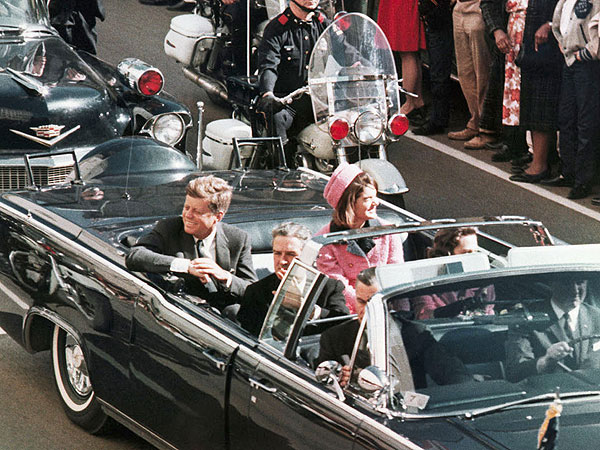
| President Kennedy moments before he was assassinated in Dallas, November 22nd, 1963. (Courtesy: People). |
(The following was written a year ago to commemorate the 50th anniversary of the Kennedy assassination. It was heretofore unpublished.)
“It's
no wonder that truth is stranger than fiction. Fiction has to make sense.”
-Mark
Twain.
“In
my stars I am/ above thee, but be not afraid of greatness…
/Thy
Fates open/ their hands. Let thy blood and spirit embrace them.”
-Shakespeare
(Twelfth
Night, Act II Scene V).
In
the course of our recent, dare I say uniquely-American, “celebration” of the
fiftieth anniversary of the assassination of President Kennedy in Dallas, and
the frantic hunt by conspiracy theorists and other scholars to finally discover
some long-hidden deeper meaning to it all—a desperate search to finally find
out “why?”—I came to a realization that shines light on the story
from an entirely different perspective. It’s really the most important
perspective that we have; and sadly it’s sometimes overlooked, taken for
granted by too many of those who have seen it.
If
there is any deeper meaning to be gleaned from the events of November 22nd,
1963 in Dealey Plaza, it lies with one man, a very certain
shooter who was standing on that infamous grassy knoll. No, not that kind of shooter. My meaning isn’t
some shadowy character hiding behind a picket fence with a gun. That sort of
shooter only lives in the minds of Oliver Stone and his ilk. The shooter I reference,
on the other hand, is very real and easily defined. He was armed not with a
sniper’s rifle, but with a Zoomatic 8mm video camera. He shot not bullets at
the President, but instead the most important 26.6 seconds of grainy silent
film ever taken in American history.
His
name was Abraham Zapruder. And as Jack Kennedy slumped over into his wife’s lap
and died, it was Zapruder who quickly became the most important man on the
scene. In an oddly prophetic way it seems appropriate that it would be the
Ukrainian-born dressmaker who filmed the only visual evidence of the most
infamous murder of the twentieth century. Especially considering his origin,
that he ran halfway across the globe to escape the horrors of the Russian Civil
War and the consolidation of Lenin’s hold on power, it comes across as a darkly
perfect example of an “only in America” moment—the idea that anyone from
anywhere can be anything—that the foreign-born small business man would have
his name forever attached to the name of one our nation’s most revered leaders,
immortalized for the ages by the ghastly sight of “Zapruder frame 313” (the
ever-chilling image of the third bullet tearing through Kennedy’s head).
But
that’s not really enough, is it? Something larger tugs at the mind. Perhaps
this is something grander in scale, a proof of Shakespeare’s human universality
that “some have greatness thrust upon 'em,” that anyone can by chance (be it
luck, fate, or however else you might have it) become, if not powerful, at
least of the highest importance.
Perhaps
we really have been looking in the wrong direction. Perhaps we’ve spent too
many years looking for why Jack Kennedy died and not enough time thinking about
what his death really meant. For what it’s worth, I don’t hate Kennedy. On
balance, I have something of a respect for him. A man whose platform was for
tax cuts, balanced budgets, and civil rights was an admirable man indeed. Throw
in a hard line against the Soviets and communism, and that goes double. His
firm stance during the Cuban Missile Crisis, worthy of its long remembrance in
the American mind, was rightly the genesis of his legacy. But, fittingly
enough, his was a legacy that to survive almost had to be sealed in blood.
“Camelot,”
that gaudy monstrosity of a name by which we’ve been told we are to remember
that lurid time, was a lie, even if it was a good one. From his supposed
perfect marriage to the fashion icon wife, to his rock-star persona (with the
built-in personality cult), and the constant parties, the omnipresence of
refined culture and high society, everything surrounded by regal furnishings,
it was all a hollow sham. In his real personal life he was anything but
virtuous. He was an idealist, and maybe a great one at that, but he was a much
better at saying than he ever was at doing. “Getting things done,” as we call
it, would be left to that wretched lug Lyndon Johnson, and get things done he
sure did (not just stopping at the just and noble goal of civil rights; but
continuing on to an alarming big government state, his “great society,” whose
own legacy ought to be forever questioned in its own right).
No,
much like the mythic King Arthur and his court, the Kennedy Camelot wasn’t real.
More importantly it wasn’t the real America. Shakespeare’s quote from Twelfth Night has two other parts; a large
fraction of the other great leaders in American history all did great big
things, they were amongst the some who “achieve greatness.” Washington,
Lincoln, Jefferson, Hamilton, Madison, Reagan, both of the Roosevelts,
Eisenhower…the list of names that come to mind goes on and on. Kennedy, however,
was different. Jack Kennedy was “born great,” but achieved little. Jack
Kennedy, whatever good there is to say about him, is nothing quite like anyone
on the list above (regardless of how you feel about him or anyone on that
list). He was a rich kid with connections and a good war story (this is not to
discredit the valor of his service), “chosen” by his father to be President
because his older brother had the bad fortune of dying young.
Abraham
Zapruder, on the other hand, was exactly what defines “the real America.” He
was a self-made man, not of great distinction, but not of poor disposition,
either. He came to the other side of the globe not for any guarantees, but for
a chance to succeed (not at all unlike my own grandfather, incidentally). In
the course of many years spent in the shuffle of the free market, he had the
good fortune of doing well for himself. By that good fortune he bought a movie
camera, a top of the line model.
This
fairy tale of Camelot simply could not survive forever. At some point the
bubble would have to burst, yet no one could ever have expected it to play out
the way it did. It all ended with a crack of thunder when the President was
slain in the back of his own limousine as it rolled down Elm Street. And
Zapruder just stood there and watched, and filmed. Jack Kennedy died, and the
car sped off. The metaphor in there is dark, but it can’t be denied. Zapruder
and his film are the real America, watching in stunned silence, as the great
sham falls apart in front of them. And then, as he rolled off screen, the real
America switched off its camera and moved on. The lie was now unraveled, even
if violently and unexpectedly so. It was now relegated to memory, an image of a
time that was. But Zapruder’s world, the aforementioned “real America,” is
grounded in firmer reality, and so outlived Camelot.
In
the end, regardless of any symbolic meaning that may be gleaned from the
circumstance of his death, the fact remains that Jack Kennedy really and truly
died for nothing. While many specifics
will always remain vague, general motive is unbelievably straightforward: Lee
Harvey Oswald, the discontented Marxist sociopath, struck out, alone, just so
that he could finally prove to the world that he was powerful (Peter Jennings
and computer animator Dale K. Myers, in The
Kennedy Assassination: Beyond Conspiracy, present a powerful visual
argument that lays sole responsibility on Oswald). Around this, the who, what,
when, where, and how of the crime all fall into place with relative ease. The
complete opposite of Lincoln and Booth, Oswald’s personal interest in Kennedy
was all but negligible. Kennedy was condemned by sad coincidence; Oswald’s
animus against Kennedy stems only from that fate had decided to drive the
President past his place of employment before anyone else of public importance
could be. The homicide of the century was set in motion not by hungry schemers,
but by total chance. A roll of the dice, if you will.
Such
a concept ultimately leads to a sort of psychological disconnect. We can’t
accept this, William Manchester explains, so we let ourselves believe in things
that we can’t prove. He says, “to employ what may seem an odd metaphor,” we
don’t have any problem accepting the Holocaust, because if the two sides were
put on a scale “you have a rough balance: greatest crime, greatest criminals.”
Put Kennedy and Oswald on either side of the same scale, however, and the
President weighs it down. So “you want to add something weightier to Oswald. It
would invest the President’s death with meaning…He would have died for
something. A conspiracy would, of course, do the job nicely.”
Somehow,
after all of this, yet one more strange twist of irony remains. Whatever
personal resentments Oswald may have harbored against Jack Kennedy, killing him
may very well have only served to set him free. A brief examination of
contemporary history shows that the constraints of time (particularly second-terms)
have a long record of causing fatigue. Influences wane, and new guards are
swept in. But this isn’t so with the dead Kennedy; there are no term limits on
martyrs, and for his personality cult, that’s what he had now become.
“Camelot,”
as a name for the time, wasn’t even a thing until after he died. Jackie came up
with it. Camelot was a musical, and
apparently his favorite line was "Don't let it be forgot, that once there
was a spot, for one brief shining moment, that was known as Camelot." Evidently
she wasn’t sure if that was obvious enough, so she kept going until all of her
doubts were erased. "There'll be great Presidents again," she goes on,
"but there'll never be another Camelot again … it will never be that way
again."
But
what if he hadn’t died? What if that “brief shining moment” hadn’t been so
brief? Would Jack Kennedy have been such a uniquely great President, would that
spot still have been known as Camelot? Well, in a word, no. Had he lived to see
the end of his first term and moved into his second, I see a Presidency that
would have played out like a watered-down Johnson administration. With his
support for civil rights and fierce opposition to the communists, he still would
have crushed Barry Goldwater in ’64. Like Johnson, he would be long remembered
for the Civil Rights Act of 1964, but in his own time likely affected by Vietnam. No, this Camelot wouldn’t have ended under a storm of
bullets, and wouldn’t have been remembered as such. This Camelot would’ve
collapsed under the weight of hard reality, washed away by the second coming of
Tricky Dick.
-Mitch Carter, a history/secondary education major at Aurora University, is an Illinois State Scholar and member of the Kendall County Young Republicans.
-Mitch Carter, a history/secondary education major at Aurora University, is an Illinois State Scholar and member of the Kendall County Young Republicans.

No comments:
Post a Comment