Friday, March 21, 2014

Record Column: Address to the American Legion: “Pondering the Purpose of the State (Relative to the Citizens).”

(The following address was first given to the Plano American Legion on January 26th, 2014, for the American Legion Oratorical Contest, where it won local and district honors; it was given again on March 1st at the Peoria Civic Center, where it took 4th place in in its division in the semi-final round of the State competition).

My fellow Americans, good afternoon;

Recently, when asked after a reading of Pericles’ Funeral oration, his address to Athens at the close of the Peloponnesian War, to ponder whether the state exists to serve the citizen, or if that arrangement is really meant to be the other way around, I found that I disagree with the premise of the question: in reality, all individuals must serve their country in some way, even if not compelled to do so or done directly through state machinery. The question is the degree to which the individual should be compelled to serve their state and the degree to which the state should be expected to serve its people.

In nations like those dominated by figures such as (to cite examples relevant to the our contemporary time period) Arab Ba’athist strongmen of the likes of Saddam Hussein for decades in Iraq, or the multi-generational rule of the Syrian Assad family, the individual is compelled to submit himself to his rulers, or else face virtually any consequence that the regime could possibly seek to pursue against them. How does such a ruling party serve its subjects? This question is much easier to answer: it simply doesn’t. Rather, this state leaves its people living in squalor while it occupies its time with matters it finds much more pressing, namely gaining, maintaining, and expanding power, notably through means like war and genocide, both along ethnic or religious lines (the Sunni Hussein and his Kurdish rivals) and along national lines (the Iraqi Hussein and the Iranians). As enlightened Westerners, we have the inclination to see this as ethically and morally reprehensible and to recognize such an arrangement by one word: dictatorship.

The American system, however, is framed so as to attempt to avoid the known flaws of top-down government, and as such is built around the mankind’s natural order of liberty in nature. In Federalist 51, Madison, writing as “Publius,” argues in his “Ambition must be made to counteract ambition” passage, the “if men were angels” quote, that in framing good government, “the greatest of all reflections on human nature,” “the great difficulty lies in this: you must first enable the government to control the governed; and in the next place oblige it to control itself. A dependence on the people is, no doubt, the primary control on the government; but experience has taught mankind the necessity of auxiliary precautions.”

In a sense, this line of thinking, that the people must serve as both their own leaders and as a check on their leaders, can be condensed into President Lincoln’s famous “government of the people, by the people, for the people”, which brings us back around to our original thesis. In order for the free state to exist and function properly, the citizen must serve it (“of the people, by the people”), and in return the state serves the citizen (“for the people”).

 Hamilton (also under the pseudonym Publius) writes that “the vigor of government is essential to the security of liberty; that, in the contemplation of a sound and well-informed judgment, their interests can never be separated;” Government, in other words, exists for the purpose of maintaining order in its jurisdiction, and in the more perfect state, to protect the natural, unalienable rights of the people, as they are outlined by the natural law, Jefferson’s “WE hold these Truths to be self-evident, that all Men are created equal, that they are endowed by their Creator with certain unalienable rights, that among these are Life, Liberty, and the Pursuit of Happiness” (the Constitution, as outlined in its artfully crafted preamble, works to achieve these exact ends). By maintaining law and order, the strong and essential trunk from which other branches may sprout, the state successfully fulfills its duty to serve the citizen (again, “for the people”).

But someone must go about the business of defining what the law should be, and still more people are required to go about the business of enforcing this law, and maintaining the state’s sovereignty in relations with the various other sovereigns that together make up the nations of the globe. As a magnificent lens through which we may view the intentions of the Founders, the Constitution’s aforementioned artfully crafted preamble not only sets forth these very same objectives—“establish Justice, insure domestic Tranquility, provide for the common defence”—as the basis for the legitimate functions of government, but also establishes who should be responsible for maintaining these conditions: in big letters, “We The People,” or the citizens themselves. Together, as a collective of citizens acting as “We The People”, the lawmakers, law enforcers, and the military that serves our nation, make up Lincoln’s “of the people.”

Not all must, however, serve in any public office to serve the state, and most do not. But that does not mean that it is not within all of our individual powers to serve our state, and our services do not necessarily have to be filtered through the machinery of the state. In fact, the first and foremost thing you can do for your nation is rather simple, and George W. Bush said it quite well: “I encourage you all to go shopping more.” Though it sounds silly, almost ridiculous in is simplicity, the larger point he is trying to make is that if we can’t serve our nation any other way, the very least we can do is to do whatever we can to help drive our nation’s economic growth. And of course, not all money that we bring in can be spent as we desire: we all must pay out to that most despicable of things, taxes, so that our government can, in theory, afford to properly maintain law and order, and thus complete the great circle that is the relationship between the citizen and the state.

But, arguably more important to that, is the one service to the government that we are so lucky to be able to perform; a service that in actuality may be construed as a service truly to ourselves: the vote. In order to achieve and maintain a government of and for the people, it must also be composed “by the people,” by ballot in election. And with the people’s power to vote, to choose their leaders, to decide their own future, Lincoln’s Great Triangle of “government of the people, by the people, for the people,” is thus complete, and all debts of service between the citizen and his state are finally paid in full.

Thank you very much, and God bless the United States.

-Mitch Carter is an Illinois State Scholar and an Associate Member of the Kendall County Young Republicans. He blogs at CartersCornerPR.blogspot.com.
CartersCornerPR@gmail.com

Monday, March 17, 2014

Carter's Corner 2014 Illinois Republican Primary Endorsements:

Ah, primary season, that wondrous time, is upon us again; that joyous time of vicious intra-party conflict and distribution of (what a good friend of mine calls) the most "distasteful and backhanded political materials" money can buy. Tomorrow, it all finally comes to an end, and we'll have our candidates set for another crack at the difficult task of ousting the entrenched Illinois Democrat establishment of Madigan-Cullerton-Quinn, and all the rest. But before we get that far ahead of ourselves we must, of course, first vote to nominate our various candidates. Here are my endorsements, from the county level on up.

Kendall County Board, District One:
Tomorrow, the residents of District One are being asked to nominate three Republicans out of a field of five for the general election. Here, I shall endeavor to highlight two names in particular: Matt Prochaska and Chris Funkhouser, both of whom I have known and been involved with through the Kendall County Young Republicans. Prochaska has already proven himself as a capable member of the county board; Funkhouser has done so similarly in his position as Alderman in Yorkville. Both have proven themselves actively dedicated to Republican causes within Kendall, and are deserving in your support.
Endorsement(s): Matt Prochaska, Chris Funkhouser.

Kendall County Board, District Two:
The voters of District Two are being faced with a similar task tomorrow: to choose two Republicans from a field of three. As a resident of District One, I'm speaking on this from the outside, but I would like to make use of this space to endorse for reelection Scott Gryder, who also serves as Chairman of the Kendall County Republican Central Committee. Under his excellent leadership, the GOP has continued its dominance over Kendall County; continuation of this same sort of leadership on the county board can only come with the highest recommendation.
Endorsement: Scott Gryder.

Kendall County Clerk & Recorder:
A successful businessman and longstanding involved member of the community, Dan Koukol has displayed in his history of civic involvement the sort of character that Kendall needs in the Clerk & Recorder's office.
Endorsement: Dan Koukol.

Kendall County Sheriff:
A lifelong Kendall resident and family friend, I can personally attest that the sort of character and integrity that brought Dwight Baird up through to the top of the Oswego police department is that which marks the sort of leader that Kendall county needs as its Sheriff. His tenure at the head of an accredited department has led to his being named 2014 Police Chief of the Year by the Illinois State Crime Commission, and I am beyond honored to lend him my support.
Endorsement: Dwight Baird.

State Representative, 50th District:
Here I've found a field of four candidates who I've unfortunately not had the time to familiarize myself with as much as I have others, but one holds his head above the rest: Keith Wheeler. Wheeler has found success both in business and in political activism. Wheeler has at times also served at the head of both the county Republican Candidate Support Committee and the Central Committee; he currently serves on the Board of Directors of the Aurora Regional Chamber of Commerce, and is both a local and state leader in the National Federation of Independent Business (NFIB). His experience and leadership is sorely needed in the broken body that is the State House of Representatives.
Endorsement: Keith Wheeler.

State Representative, 75th District:
Over the past year or so, it has been my distinct pleasure to get to know State Representative John Anthony, who is finally beginning to receive well deserved recognition for his longstanding service to our community. Prior to his appointment to the legislature, Anthony had served in law enforcement since 2005, and served as a Kendall County Deputy Sheriff; in his spare time, he formed the non-for-profit YARN Foundation to assist with strengthening local families and to aid at-risk youth. In his brief tenure as a State Representative, Anthony has already been named an "Emerging Leader" by GOPAC, a national Republican activist organization. Similar to Mr. Wheeler, Anthony's extraordinary character and integrity, and exceptional history of community service, are the exact sort of example that the State House desperately needs.
Endorsement: John D. Anthony.

US House, 11th District:
I've gone back and forth with this one; I've personally head remarks from both Bert Miller and Chris Balkema (the latter I've heard twice), and been impressed with both; I am surely glad that I won't be the one having the make the choice between the two in the voting booth tomorrow. However, Mr. Miller's delivery at a candidates forum put on by the Kendall GOP may have been enough to sway me to his side; his comparison of President Obama and the incumbent administration to a jar of marshmallow fluff he held up at the lectern was a moment I won't soon forget. An outspoken leader, Miller has spent the past four decades building the plastic bottle-cap manufacturing company Phoenix Closures into the success that it is today earned him honors as the 2007 Illinois Institute of Technology Entrepreneur of the Year; his is a voice that the people of the 11th deserve to represent them in the House.
Endorsement: Bert Miller.

United States Senate:
The Republican primary race for Senate that was very recently thought to be entirely locked up by State Senator Oberweis has since become quite the storied saga, and I won't bother to rehash the details all here. What I will say is this: while I have tremendous respect for Jim Oberweis, and I know good people who work under him, it has occurred to me that a better option exists for all of us. Doug Truax, who lays claim to such as prestigious honor as being as West Point grad, and can boast of being a successful business person himself, despite recent economic troubles, is a fresh and promising face on the Illinois political scene. Where I see Oberweis as angling for the nomination almost as if simply because it's "his turn," despite only being able to claim one electoral victory in over a decade of repeated attempts; Truax, meanwhile, seems to me not only dedicated to the difficult task of taking on entrenched Senator Dick Durbin, he displays all the signs of being fully prepared to bring the fight directly to him. Regardless of the the result of the general election, a come from behind victory by Doug Truax in tomorrow's primary is precisely what the state GOP needs at this moment in time, and I do believe his presence this fall may be enough to put Illinois in-play on a Senate map that is already overwhelmingly favorable to the Republicans.
Endorsement: Doug Truax.

Governor of Illinois:
The toughest choice on the entire ballot will, somewhat poetically, also be the biggest. Over the past few months, I've found that reaching a decision on who to support for Governor may best be done process-of-elimination style. First off the list is State Treasurer Dan Rutherford; regardless of their validity, personal charges against him have very plainly shown to be more than he can get past. Though we've had at least one friendly chat on Twitter, I can't call myself much of a fan of State Senator Kirk Dillard, who famously cut an ad in support of Barack Obama against Hillary Clinton during the 2008 primary cycle (on a semi-unrelated note, he used to be Jim Edgar's Chief of Staff).
That leaves State Senator Bill Brady, our 2010 nominee, and a newcomer, venture capitalist Bruce Rauner. In a optimal world (feel free to laugh at the idea of Illinois being an "optimal world"), Bill Brady would clearly be my first choice from governor; given the legislative body he has spent the past decade serving in, his is an exceptional record. But he had his turn to take on Pat Quinn, and he very sadly fell just short of what was needed to oust our loathsome Governor; in a climate that I can't say with any certainty whether it is likely to be as favorable to the Republicans as it was in 2010, I'm not sure that a second shot at Quinn by Brady will yield any different result (we can't all be Dick Nixon).

Tribune editorial cartoonist Scott Stantis' excellent cartoon in support of Bruce Rauner for Governor of Illinois.
(Courtesy:
Chicago Tribune).


So, that leaves Rauner. Ever since learning of him and his new-found political aspirations through the Tribune's excellent commentary legend John Kass (whose political instincts I darn near trust with my life), I have been quite interested in Mr. Rauner. Revelations of prior involvement with Rahm Emanuel and others have left me somewhat shaken, but I've somehow found myself repeatedly dissuaded from leaving his side.
I do take his devotion to fiscal conservatism as genuine, and I'm incredibly cheered by his devotion to education reform and to term limits (which Illinois is in such desperate need of). Above all else, my number one mission in 2014 (aside from seeing Mitch McConnell replace Harry Reid as Senate Majority Leader) is to see Pat Quinn finally ousted from power, and when I look out at the Republican field, I see one man with the capability to do it best of all: Bruce Rauner.
Endorsement: Bruce Rauner.
-Mitch Carter is an Illinois State Scholar and an Associate Member of the Kendall County Young Republicans.
carterscornerpr@gmail.com
Twitter @CartersCornerPR

Sunday, March 16, 2014

A Theory or Two on Flight 370

Projected flight path of Malaysia Airlines Flight 370.
(Courtesy: CBS News).


Given the chaos and confusion already widespread, I avoided putting anything like this online until now, but as recently as the middle of last week a strong suspicion washed over me: the vanished Malaysia Airlines Flight 370 was hijacked. It was when I first saw the alleged flight path that the plane apparently took after the ground lost contact, a sudden turn sharp turn east from an original northern heading. Something about it reminded me of the flight path of American Airlines Flight 11 all those years ago, as it swerved over central New York from its easterly Boston-to-LA path southward towards its eventually collision with the north tower. They were too eerily similar, somehow. A plane doesn't just do that and not be heard from. There had to be something foul at play.


I initially ruled out al Qaeda (and/or their ilk) as suspects; being as it is still missing, it seems as though Flight 370 never hit anything, and I struggle to think of a high-value target in the Indian ocean. But then I pondered further; that's immediate-post-9/11 thought, and it foolishly assumes that aQ has never evolved. Obviously, they have; it was barely three months after 9/11 that Richard Reid attempted the shoe bomb plot, and of course there was the Christmas Day Underwear Bomb plot of 2009. aQ has been angling at a soft target strike of this sort for years.

But that's only the foundation. Then, this week, two more stories appeared on the Drudge Report that now become what allows my theory to truly hold weight. First there is the testimony of captured British jihadi Saajid Badat, who claims to have passed a shoe bomb "to several Malaysian men who wanted to blow open a plane’s cockpit door and carry out a 9/11-style hijacking of their own" at some point in the past. Even if this wasn't the same bomb or the same hijackers who may have taken Flight 370, we can now establish that there were channels for moving ordinance into place for such an operation.


Uighur jihadis are known to have fought alongside fellow radicals in the ongoing Syrian Civil War "After receiving orders from al-Qaida," further heightening their ties; and the Chinese have previously charged Turkey with "playing a role in recruiting and financing the Chinese fighters." So could they have possibly have collaborated on an operation in southeast Asia?

I can't speak with any certainty, nor can I even assign any accurate probability to my suspicions, but yet I still wonder: what if a Turkish al Qaada affiliate (or other radical cell) supplied Chinese radicals in Malaysia with an explosive device (or more), and set them off to due their work. For further consideration, the majority of the passengers on board were Chinese nationals, just as were the targets of every other recent Uighur attack. If I were correct (again, I have no way to tell until we learn much, much more), every angle would be covered: Uighur militants get their terror strike against the Chinese, aQ gets their high profile pubic scare-attack.

Countering my theories, now, is the revelation the the pilot was a "'fanatical' supporter of the country (Malaysia)'s opposition leader Anwar Ibrahim - jailed for homosexuality just hours before the jet disappeared." Could the disappearance be a revenge strike against the Malaysian ruling party? This theory admittedly has just as much weight as mine, with an even less convoluted plot required to carry out.

Was Flight 370 taken down in part of global terror strike, or a revenge stunt by a politically disgruntled pilots? The evidence is certainly there behind either story, yet what makes it so frustrating (doubly so for the overwhelmed Malaysian investigators) is that nothing can really be decided with any certainty. Anything, it seems, is possible now.
-Mitch Carter is an Illinois State Scholar and an Associate Member of the Kendall County Young Republicans.
carterscornerpr@gmail.com


Wednesday, March 12, 2014

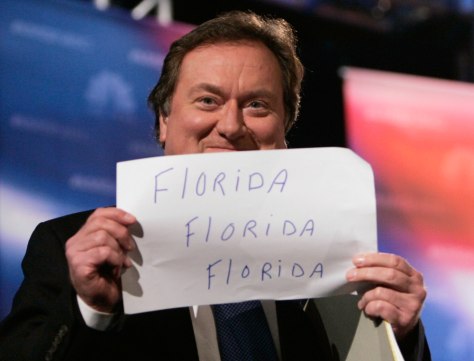
Florida's 13th -- The Bellwether for 2014?

Tim Russert's call on election night 2000.
(Courtesy: NBC News).
I was intrigued by the Fox News tweet announcing the result in the special election to replace the late Rep. C.W. "Bill" Young (R) in Florida's 13th District: "BREAKING: Republican David Jolly beats Democrat Alex Sink in #Florida special election seen as #ObamaCare referendum." "Obamacare referendum?" Maybe I should have payed closer attention to this; after all, it seemed all the political world was: Bill Clinton led a charge of nationwide Democrats involving themselves with the race, and contra him was Rand Paul, whose recorded phone call may very well have swayed enough support away from the Libertarian candidate to guarantee Jolly the nearly two points he claimed victory in a race that saw nearly $11 million spent (outside money, I'm sure it wasn't).

Primary season is in full swing as we speak, and November is barely eight months away from us now, I can't help but wonder: does the nation go as does central Florida? In a district that leaned for Obama in 2012 (and Bush in 2000), where half of all votes are believed to be cast by voters over the age of 65, the possibility is very real.


That point will be predictably disputed, and with some merit. But I'd like to nonetheless think there's something more to last night's results lurking under the surface. The most recent polling had Jolly, who was outspent 3 to 1, losing by three points and on the defensive regarding his stances on entitlements; heavy Republican emphasis on Obamacare, it seems, is what pushed him through to the lead (similar late-race emphasis by Ken Cuccinelli also brought him near to becoming Governor of Virginia, though various other political circumstances ultimately proved too much).


President Obama has already offered to keep away from vital Senate races, like Arkansas and Louisiana, "where his presence would not be helpful" in the Democrat's quest to retain control of the Senate. And now, with a key district in ever-purple Florida being taken by an optically-poor  lobbyist who just happens to be a "just-divorced, 41-year-old" "accompanied on the campaign trail by a girlfriend 14 years his junior,"(as per today's Playbook) with twice as many votes as the President took it by sixteen months ago, just as new polling suggests Mark Udall's Senate seat in Colorado (previously considered extremely safe) may be in play for the GOP as it expands the map for 2014, perhaps the Democrats have something even more to fear.

-Mitch Carter is an Illinois State Scholar and an Associate Member of the Kendall County Young Republicans.
carterscornerpr@gmail.com

Friday, March 7, 2014

Record Column: Back at the House

Kevin Spacey as the manipulative master politician Frank Underwood in House of Cards
(Image courtesy:Netflix).
(Warning: Spoilers very well may lie ahead).

There was a poster going around the internet, a picture of Kevin Spacey and Robin Wright, the top of which read “Everyone is like Valentines Day is this Friday,” over a bottom reading “I’m like Frank Underwood is back this Friday;” I felt as though the words were being taken from my own mouth. I’ve never had much interest in Valentine’s Day, I generally regard it as useless (“I have no patience for useless things”). At most, it’s an excuse for relationship people to be even more annoying than usual. But I long awaited this year’s Valentine’s Day with an anticipation like no other, not in expectance of some great occasion of joyous love, but something starkly opposite: February 14th was the time to finally “let the butchery begin,” again.

February 14th marked the return of Kevin Spacey’s most recent master-role, Francis J. “Frank” Underwood (D-South Carolina, but probably more accurately D-Eighth Circle of Hell), a Machiavelli-meets-Macbeth pure-evil Washington power player, the now-former House Majority Whip who, in thirteen riveting episodes of historic made-exclusively-for-Netfix TV, connived and killed his way to the Vice Presidency. And that was just the first half of the scheme.

If Season One’s arrival was marked with its historical importance as possibly the first “primetime”-style American television series to premier online (technically, the excellent Steven Van Zandt series Lilyhammer premiered a whole year earlier, but it was originally produced and aired in Norway)—with the added distinction of being the first online-only series to win a major acting award (Robin Wright’s Best Actress Golden Globe)—, the premiere of Season Two was a political event, with Kevin Spacey even showing up on This Week with George Stephanopoulos two mornings after the premiere to discuss the show’s undertones.

Armed with a Netflix account (who isn’t) and already engaged in the plotline as I was, and not being one to miss out on such a discussion-worthy event, I set forth on a mission: blessed with a Friday and following Monday off of school, I was going to watch all thirteen episodes, nearly three months of programming in “normal” TV time, in the space of four days. This is clearly a bizarre way to consume popular entertainment, yes, but I do what I must.

So there I sat in a recliner chair, alone in a dimly lit living room, at 11:47, waiting for the show to hit Netflix. I couldn’t have been more ready; House of Cards really is best viewed alone and in poor light, it sets the mood perfectly, as if the viewer themselves are immersed in the dark and murky waters of grand conspiracy. I passed the time tweeting (@CartersCornerPR) in anticipation, and reading the anticipatory tweets of others, until finally the clock struck midnight, and it was time to get going.

Except it wasn’t.  At both 12:01 I clicked on the show’s icon, ready to see a big “watch Season Two” button waiting for me. But it wasn’t there. I restarted the Wii I was using, only to find that the show still wasn’t available. But how could this be?! I retrieved my phone and inquired to Google where the show was, when it was all finally revealed: the new episodes weren’t going to drop until midnight pacific time. Three in the morning here. A whole two-thirds of a land mass spanning across a continent was waiting on the third.

Somehow feeling a sense of failure, I went to bed in disgust, wondering how much the big-time media types must be getting paid to stay up for this—before they even got around to binge-watch almost 13 hours of TV. And now, at bare minimum, I would be six hours behind schedule.

That estimate turned out to be a bit off. After a long day of something that wasn’t watching House of Cards, I finally found an opportunity at around 8:00 to settle in for a lengthy viewing session. I mentally noted that, aside from being a Friday (Friday night is where TV goes to die), this was a fairly “normal” time for watching television, despite how odd it felt to be “late” in getting started. Is this our future? Are we destined to watch whatever the hip and cool new show is in several-hour blocks at times of our own choosing?

No matter, it was finally, finally, time to check back in with Vice President Underwood. I’ve never been this happy to see a Democrat in such a position of power. He got right down to business; forty minutes in, he finds a central character from the first season, a reporter who he used as a secret outlet for information he wanted leaked (in exchange for her getting credit, and by extension, fame, for the big insider scoops), has outlived her usefulness. So he kills her.

Frank’s too far in now to let up now, and he’s still got distance to cover. In Season One, Frank taught us the secret method for devouring a whale: “one bite at a time;” this year, every bite he takes is bigger than the last, and now the power-hungry gentleman from South Carolina is licking his chops at the biggest whale of them all.

Having paused for a break at some point, I had finally rolled through about half the season by 3:00 in the morning. I literally passed out and found it was noon when I woke up; colluding to steal power seems a most consuming sport, even from a solely observatory position. In reflection, I was humored by a plot point that almost went out of its way to prove that the show existed in an alternate form a reality: when the Senate Republicans threatened to force a (gasp) government shutdown, the Democrat White House seems genuinely fearful that they would take the blame for it. If only. So of course, Frank puts on his Senate-President hat and strings together the votes to avoid the crisis.

Little changed Saturday night, as Frank steadily works his way closer and closer to the ultimate goal, though I sadly made it through only a few episodes. Late Sunday night, then, I found myself thusly: with about 24 hours remaining from my deadline, I was 5 episodes away from the big finish.

That night, I charged forth with renewed focus, before I stopped after episode 12; much like Frank, I was positioning myself to overtake the last position. When I awoke that Monday morning, I was refreshed and ready to finish it off. But not yet; the right thing to do was to put it off, waiting for the perfect moment to initiate the endgame. That’s how Frank would do it.

Finally, at seven, I couldn’t take it anymore. I had to know. Not how it would end, per se, but how we would finally arrive at the finish. The ending was already obvious enough to anyone who had even a hint of how Season One concluded (when my old boss got angry with me on FaceBook for revealing the last moments of the finale, I responded “C’mon,…you didn't think he would stop at the last minute and take a job as dog catcher, now did you?”);  much like they say about success, House of Cards is not about the destination where it all ends, it’s about the journey to get there.

Much like last year’s offering, Season Two was doubtlessly anything but perfect; some plotlines seemed a tad overly strung out at times, with certain scenes that I felt were only included because this pay-for-premium-TV, darn-it, so they can throw in whatever they like. But my gripes aren’t nearly enough to sink the show, so outweighed by the fantastic work being done all around: Robin Wright continuously proved that earned every ounce of that Golden Globe for her chilling performance as Claire, her effectiveness only further proven by how much I’ve come to detest her wicked and unscrupulous monster of a character; the magnified role of Freddy and his BBQ Joint was a refreshing, then heart breaking, turn away from all that politics and stuff; and evolution of Raymond Tusk from a minor side character to a major, loathsome figure was excellent, especially as it pertained to a fantastic plot line concerning relations with the Chinese.

But above all, the prime rib on the menu was, as before, Spacey’s marquee performance as the monologuing Underwood, the malicious schemer who has the most on the line, yet oddly seems to be the only one ever having any fun. And, at the end, when he finds himself alone in that office, and gives the camera that menacing stare, before he pounds the desk with his signature double-knock as screen goes black, a profound sense arises that everything good and bad in two seasons built directly to this. And it was all worth it.

Now, we wait for next season; now, it’s time to get down to business.
-Mitch Carter is an Illinois State Scholar and an Associate Member of the Kendall County Young Republicans. He blogs at CartersCornerPR.blogspot.com.

CartersCornerPR@gmail.com
@CartersCornerPR 


Tuesday, March 4, 2014

A New Guilty Pleasure.

Just as the whole crisis with Putin's little incursion into Ukraine (you know, the one where he's holding all the cards and asking us if we want to say something about it) is finally getting beyond out of hand, I was delighted today to discover what may be my newest guilty pleasure: Mark Leibovich, author of last year's epic dish-out on inside Washington, This Town, has a new regular column for The New York Times (the first reason for me to actually regularly visit The Times since the departure of Nate Silver), which I am happy to report is written very much in the same style as his book. His first target? Possibly the most "This Town" race in America, in a place about as far from "This Town" as possible: the race for Senate in Kentucky. The highlights are fantastic:

"McConnell and Grimes may be the main combatants, but the front lines of affront in this Bluegrass State battle are occupied by the competing spokeswomen, Norton and Cooper. They brim with enthusiasm for their jobs, their candidates and their country. But perhaps more important, they are fluent in the lingua franca of chagrin, and eager to share with us — via clinically composed news release, email, tweet or whatever — how deeply troubled and appalled they are by something their opponent did, didn’t do or might possibly be associated with...

Not long ago, the privilege of speaking publicly on behalf of a candidate belonged to a select few operatives, usually 40- and 50-somethings who spoke with deliberate authority and, in the case of Senate races, often had deep ties to the candidates, the state and political reporters. Things have changed. Norton and Cooper, 25 and 23 respectively, are typical of young political operatives at work today. Each speaks with a Southern accent, though neither is from the South, let alone Kentucky. When this race is settled, there’s a good chance each will turn up working for another candidate somewhere else, condemning the dishonest attacks of their opponents, demanding apologies that will never come and telling us what the people of said state are sick and tired of. The job now requires no special education or experience, no roots to a state and no affiliation with a candidate. The prized skill set is merely the ability to get your noise heard above the rest of the cacophony, which, of course, just creates more noise...compared with even five years ago, political races now exist fully in an anarchic hyperspace that creates a synergy of desperation between the feeders and the beasts. “Sometimes I would put out a bunch of press releases, and some reporter will call and say, ‘You know the other guys are putting out more stuff,’ ” says Brian Walsh, a former spokesman for the National Republican Senatorial Committee. The media, Walsh says, is as invested in the game of back and forth as the actual campaigns are “even though we all laugh at the cheesiness,” he says...

If you were stuck, for example, in one of those bladder-bursting traffic jams on the George Washington Bridge, you may not have been wondering if your misery was feeding into Chris Christie’s problematic “bullying narrative.” But his ability to navigate a public-relations crisis became the prevailing data point."

Sunday, March 2, 2014

Another Line Crossed.


Russian soldiers in Crimea.
(Courtesy: Reuters).

Without going so far as to profess naivety, I admit to being partially incorrect last week: only hours removed from the closing of the Sochi Olympics, I could in no way foresee an impending Russian invasion of neighboring Ukraine. I knew plainly Putin was upset at his loss of influence in the state through his puppet-president Yanukovych, but in no way did I assume he would so quickly realign his Ukrainian agenda from indirect control of Kiev to directly taking over his own slice of the nation.

One part I did nail down correctly was Putin’s desire to draw attention to Western response (or lack thereof) to his renewed initiative; just instead of sitting back and allowing the West to make an attempt at the difficult task of reunifying Ukraine, he chose drive his own wedge into the process. As last week wore on, it started to become plainly clear to me: Putin was only biding his time until he could stumble across an excuse to “go in.” It didn’t take him long to discover some “Russian interest” at stake in internal Ukrainian turmoil, and by Saturday, Russian forces were openly operating inside neighboring borders.

The southern Crimea peninsula, with its majority self-identified ethnic Russian population, now seems to be firmly in the Kremlin’s grasp. Two questions now emerge: now what does Putin want?; and what will the West (specifically the United States) do about it?

Question 1 is tricky; later in the week, a Wall Street Journal editorial argued that Putin’s aims are far more for power than for tangible land gains: “Putin moves to carve up Ukraine if he can get away with it” (emphasis mine). Putin is doing this because he can; again, if he can’t hold sway over the nation as a whole, he’ll settle for seizing whatever he can take, thereby preventing the deeply tumultuous country from quickly putting its saga of chaos behind itself.

On to Question 2, then; As per the Journal’s weekend headline, the White House is issuing a stern “warning” to the Kremlin over what Secretary of State Kerry denounced as an “an incredible act of aggression;” we’re leaving “all options on the table,” or so he says on Sunday morning TV. Don’t be upset when Vlad doesn’t take you seriously, John; he’s heard it all before.

I seem to recall having “all options on the table” last fall when Syria was thing we were prepared to do. We plotted airstrikes against Bashar Assad, and President Obama went on TV to tell us all about why we needed to do it. That was, of course, until halfway through when he wheeled around to tell us all about how we actually weren’t, because of the miraculous peace offering President Putin made and volunteered to enforce after an unplanned response to a hypothetical question that Secretary Kerry made at a press conference. This is apparently how we enforce “red lines,” those dastardly banes of the Obama administration, that we very publicly draw against murderous tyrants who slaughter their own people with chemical weapons.

Kerry also insists that our allies are standing firm with us against Putin; if memory serves, they also stood with us on Syria until they all backed out. By the way, Bashar Assad is winning his civil war, and Forbes ranks Putin as the most powerful man in the world.
Counteracting Putin here is not impossible, but will most certainly be a difficult task to pull off, and I do not believe this White House is even close to being up for the task. As I’ve alluded to before, President Obama endlessly ridiculed Mitt Romney as being “stuck in a Cold War mindset” for declaring Russia as our number-one geopolitical enemy; as it turns out, it is Vladimir Putin, who believes the collapse of the USSR was "the greatest geopolitical catastrophe" of the 20th Century, is the one stuck in the Cold War mindset. Governor Romney was only responding to him for it.

There is little solace to be found in watching a President who was reelected on lines such as that eat crow for it. I believe that a sad fact we are doomed to live with for the next few years is that as long as Barack Obama lives in the White House, there will be little chance of beating back Vladimir Putin and his expansionist agenda on the world stage; and, contrary to whatever President Obama’s campaign talking points may have led you to believe, there is no other player on the world stage so actively and openly opposed to the West as President Putin. Events are always subject to change, sure, but from where I sit now, this much is clear: as long as President Obama resides in the White House, the United States will have little say in how long Putin holds claim to being the most powerful man in the world.

-Mitch Carter is an Illinois State Scholar and an Associate Member of the Kendall County Young Republicans.
carterscornerpr@gmail.com

Twitter @CartersCornerPR